
The Ultimate Guide to Deep Tissue Massage in Dubai: Unlocking a Pain-Free Life
Let’s be honest. You live in Dubai. You’re either hunched over a laptop in DIFC trying to conquer the world, stuck in traffic on Sheikh Zayed Road tensing your shoulders up to your ears, or you went way too hard at that Padel match last night.
Now, you have “that one spot.” That stubborn, deep knot in your shoulder blade that just won’t quit.
You’ve tried the gentle, relaxing massages. They’re lovely. You float out of the spa, sip your ginger tea, and feel great… for about an hour. But “that spot” is still there, laughing at you.
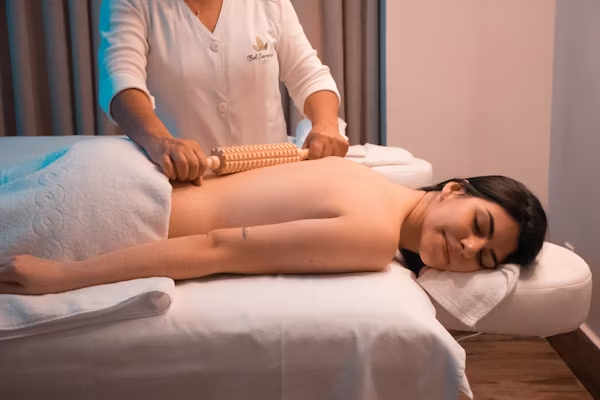
Welcome to the world of deep tissue massage.
This isn’t your average, zen-out-with-whale-music spa day. This is the massage you get when you need a fix. It’s the “call in the big guns” of bodywork, designed to get to the root of chronic pain and tension.
But “deep tissue” is a term that gets thrown around a lot in Dubai. Is it supposed to hurt? What’s the difference between this and a Swedish massage? And with prices ranging from a bargain-bin deal to a luxury hotel splurge, how do you find someone who actually knows what they’re doing?
You’ve got questions. I’ve got answers. As an SEO and wellness specialist, I’ve dug deep (pun intended) to create the ultimate guide to deep tissue massage in Dubai. We’ll cover what it is, who it’s for, what to expect, and how to avoid walking out feeling worse than when you went in.
What in the World is a Deep Tissue Massage, Really?
Let’s clear this up right away. “Deep tissue” doesn’t just mean a massage with really hard pressure. If that’s all it was, you could just have a friend walk on your back (please don’t).
It’s a specific therapeutic technique.
Forget the Fluffy Robes: This is Different
A deep tissue massage targets the deeper layers of your muscle and connective tissue (also known as fascia). Think of your muscles as a set of complex, layered ropes. A relaxing massage glides over the top layer. A deep tissue massage gets in between those ropes, untangles them, and smooths them out.
The primary goal is to find and break down adhesions.
That’s the technical term for those nasty, painful, rigid knots in your muscles. These adhesions can block circulation and cause pain, limited range of motion, and inflammation. A deep tissue therapist uses slow, deliberate, and concentrated strokes (using thumbs, knuckles, forearms, and even elbows) to physically break down these adhesions.
This process allows blood and oxygen to flow properly again, which helps to release chronic tension and heal the muscle.
The Big Showdown: Deep Tissue Massage vs. Swedish Massage
This is the most common point of confusion. Many people book a deep tissue massage expecting a “stronger Swedish,” and they’re in for a shock. Others book a Swedish and complain it wasn’t deep enough.
They are two different tools for two different jobs.
Here’s a simple breakdown:
| Feature | Swedish (Relaxation) Massage | Deep Tissue (Therapeutic) Massage |
| Main Goal | Full-body relaxation, stress relief, mild tension. | To fix a specific problem; targets chronic pain, knots. |
| Pressure | Light to firm. | Firm to deep. |
| Technique | Long, gliding strokes (effleurage), kneading. | Slow, deliberate strokes, friction, trigger point therapy. |
| Focus | Often full-body, promoting general wellness. | Concentrated on “problem areas” (e.g., neck, back, legs). |
| The Vibe | “Ah, this is so relaxing.” | “Ooh, that’s the spot. It hurts so good.” |
| Best For | A spa day, de-stressing, first-timers. | Chronic pain, athletes, “tech neck,” old injuries. |
| Aftermath | You feel relaxed, maybe a little sleepy. | You feel “worked on.” May be sore for a day or two. |
Export to Sheets
Let’s Talk About “The Hurt”: Is It Supposed to Be Painful?
This is the million-dirham question. The answer is no, it shouldn’t be painful.
But it will be intense.
There’s a huge difference between “good hurt” and “bad pain.”
- “Good Hurt” (Therapeutic): You’ll feel a deep, focused pressure on a knot. It might be tender, and you might find yourself breathing through it, but it feels… right. It feels like something is being released. This is often called a “hurts-so-good” sensation.
- “Bad Pain” (Damaging): This is sharp, pinching, or unbearable pain. It’s the kind of pain that makes you tense up your entire body, hold your breath, and clench your teeth.
If you feel “bad pain,” you MUST speak up immediately. A good therapist will never, ever tell you to just “take it.” Pushing through this kind of pain is counterproductive. Your muscles will just tighten up to protect themselves, and you could end up bruised or even injured.
A real deep tissue massage is a partnership. Your therapist’s job is to apply pressure. Your job is to breathe and give feedback.
The Science-Backed Benefits: Why Your Dubai Lifestyle Demands This
Okay, so it’s intense. Why would anyone sign up for this? Because the benefits are incredible, especially for the high-octane Dubai lifestyle.
For the “Dubai Desk Jockeys”: Saying Goodbye to Chronic Back & Neck Pain
You know who you are. Eight, ten, twelve hours a day hunched over a screen. That “tech neck” isn’t just a buzzword; it’s a physical reality. Deep tissue massage is a lifesaver for chronic lower back pain, stiff necks, and shoulders that feel like they’re permanently attached to your ears. It gets into the deep postural muscles (like the erector spinae) and forces them to release.
For the Padel Addicts & Weekend Warriors: Supercharged Recovery
Dubai is an active city. Whether you’re a CrossFit fanatic, a marathon runner, or a newly obsessed Padel player, you’re putting your body through its paces. Repetitive strain and micro-tears are part of the game. Deep tissue massage speeds up recovery by flushing lactic acid, improving blood flow to damaged tissues, and breaking down scar tissue, helping you get back on the court or track faster and with less risk of injury.
Taming the Sheikh Zayed Road Stress Monster
Did you know deep tissue massage can literally lower your blood pressure? It’s true. Studies have shown that a good massage can significantly reduce levels of the stress hormone cortisol. While a Swedish massage calms your nervous system, a deep tissue massage tackles the physical manifestations of that stress—the rock-hard traps and clenched jaw you get from just thinking about the Salik gates during rush hour.
Un-gluing Your Muscles and Improving Mobility
Feel like you can’t turn your head all the way to check your blind spot? Or that your hips are “glued” together after a long flight? Adhesions don’t just cause pain; they restrict your range of motion. By breaking up these knots and lengthening the muscle fibers, deep tissue massage gives you your mobility back. You’ll stand taller, move more freely, and feel less… stuck.
Hold On… Is Deep Tissue Even Right for You? (The Important Bit)
Just because it’s powerful doesn’t mean it’s for everyone. A good therapist in Dubai will (and should) ask you a lot of health questions first. This isn’t them being nosy; it’s them being a professional.
This is critical for your safety. We call them contraindications.
You’ll LOVE This If… (The Ideal Candidate)
- You have chronic, nagging muscle pain.
- You’re an athlete or very physically active.
- You’re recovering from an old injury (and have been cleared by a doctor).
- You have posture problems from sitting at a desk.
- You suffer from tension headaches or sciatica.
- You’ve had massages before and always feel like they “don’t go deep enough.”
When to Hit the Brakes: Absolute “No-Go” Contraindications
If you have any of these conditions, you should AVOID deep tissue massage completely or get explicit clearance from your doctor:
- Blood Clots (Deep Vein Thrombosis – DVT): This is the #1 most serious risk. A massage could dislodge a clot, which can be life-threatening.
- Fever or Contagious Disease: If you’re sick, your body is already working overtime. A massage will just make you feel worse and spread your germs. Stay home.
- Uncontrolled High Blood Pressure: While massage can lower blood pressure, the intense nature of deep tissue can sometimes cause a temporary spike. Talk to your doctor.
- Recent Surgery or Injury: Your body needs time to heal. Don’t let anyone work on an acute injury (in the first 48-72 hours) or near a recent surgical site.
- Severe Kidney or Liver Conditions: Your kidneys and liver are responsible for filtering the waste products that massage releases. If they’re compromised, this can be too much for them.
When to Talk to Your Doctor First (Proceed with Caution)
- Pregnancy: A traditional deep tissue massage is a no. However, many therapists are certified in prenatal massage, which is a fantastic, modified, and safe option.
- Cancer: Massage can be wonderful for cancer patients, but it requires a specialist trained in oncology massage, as pressure and location need to be carefully managed.
- Osteoporosis: If bones are brittle, deep pressure is a bad idea.
“Just Not on That Spot”: Local Contraindications
These are things that don’t ban a massage entirely, but the therapist MUST avoid that specific area:
- Open wounds, cuts, or sores
- Bruises (it will only make them worse)
- Varicose veins (they should work around them, not on them)
- Burns (including sunburn!)
- Rashes or skin infections
Your First Deep Tissue Massage in Dubai: A Step-by-Step Survival Guide
Alright, you’ve decided to take the plunge. You’re ready to evict that knot in your back. Here’s how to prepare and what to expect, from the moment you walk in.
Step 1: The Pre-Game (Hydrate, and Don’t Eat a Giant Meal)
This is simple but crucial.
- Hydrate: Your muscles are about to get a serious workout. They need to be well-hydrated. Drink plenty of water the day of your massage.
- Don’t Eat Big: Don’t go in right after a massive brunch. Lying face-down on a full stomach while someone presses on your back is… not pleasant. Have a light snack an hour or two before.
- Show Up Early: Arrive 10-15 minutes before your appointment. You’ll have paperwork to fill out, and you don’t want to rush in, all stressed out, and jump right on the table.
Step 2: The All-Important Chat (The Consultation)
This is the moment that separates the pros from the amateurs. A good therapist will sit down with you and ask:
- “What are your problem areas?”
- “What do you do for work?” (This tells them if you’re a “desk jockey” or on your feet all day).
- “Do you have any injuries? Any medical conditions?”
- “Have you had a deep tissue massage before?”
This is your time to talk. Be specific. Don’t just say “my back hurts.” Say, “It’s a sharp pain on my right side, right under the shoulder blade, and it gets worse when I use the mouse.” The more information you give, the better they can treat you.

Step 3: The Warm-Up
You’ll undress to your comfort level (most people leave their underwear on) and lie on the table under a sheet. The therapist will “drape” you, meaning they only uncover the part of the body they’re working on.
They won’t just dive in with an elbow. A deep tissue massage always starts gently. They’ll use lighter, Swedish-style strokes to warm up the muscles and get the blood flowing. This is both for your comfort and for their assessment—they’re feeling for where the tension and knots are.
Step 4: “Going In” (What It Actually Feels Like)
Once the area is warm, they’ll start to “go deeper.” This is where the technique changes. The strokes will become much slower, the pressure more intense and focused. You’ll feel them using their thumbs, knuckles, or forearms to slowly strip down the muscle or apply sustained pressure to a single “trigger point.”
It’ll feel… intense. You might feel the knot “fighting back.” This is normal.
Step 5: Your One Job: BREATHE (and Speak Up!)
You’ll be tempted to hold your breath when they hit a tender spot. Don’t.
Holding your breath tenses your muscles, which is the exact opposite of what you want. Your most powerful tool on the table is your breath. As the therapist presses in, take a long, slow, deep breath out. Imagine you’re “breathing out” the tension from that spot.
And remember to communicate. Use a 1-to-10 scale.
- “Wow, that’s about a 7/10.” (This is usually the therapeutic sweet spot).
- “Whoa, that’s a 9! Can you back off just a little?” (A good therapist will be happy to adjust).
This isn’t an endurance test. You’re not “failing” if you ask for less pressure.
The “Day After” Effect: Why Do I Feel Like I Got Hit by a Bus?
Okay. You survived. You walk out feeling a bit dazed, maybe a little “floaty.” You go to bed.
Then you wake up the next morning… and you’re SORE.
THIS IS NORMAL.
Do not panic. This is not a sign that the massage went wrong. It has a name: Delayed Onset Muscle Soreness (DOMS). It’s the exact same soreness you feel a day or two after a really hard gym workout.
Your muscles were physically broken down, stretched, and manipulated. They are now in the process of healing, and this tenderness is a sign of that process. It should feel like a dull, widespread ache, not a sharp, specific pain.
This soreness is why your aftercare plan is just as important as the massage itself.
Your Ultimate Post-Massage Aftercare Plan
- Water, Water, and More Water: I can’t say this enough. You must hydrate. Your therapist just released a lot of metabolic waste from your muscle tissues. Your job is to flush it all out of your system. Dehydration will make the soreness ten times worse.
- Take a Warm Epsom Salt Bath: This is the best thing you can do. The heat will soothe your muscles, and the magnesium in the Epsom salts is a natural muscle relaxant that helps reduce soreness.
- The Great Heat vs. Ice Debate:
- Heat (Warm bath, heating pad): Use this for general, widespread muscle soreness. It promotes blood flow and relaxation.
- Ice (Cold pack): Use this only if a specific spot feels inflamed or “angry.”
- Move Gently… Or Don’t: Don’t go to your F45 class or try for a personal best on your 5k run. Your muscles need to rest. A light walk or some very gentle stretching is fine. A heavy workout is not.
- Skip the Happy Hour: Avoid alcohol and excessive caffeine for at least 24 hours. They are dehydrating and will just interfere with the healing process.
The soreness should fade within 24-48 hours. After that, you should feel amazing—lighter, more mobile, and with that chronic pain significantly reduced.
The Big Question: How Much Does a Deep Tissue Massage Cost in Dubai?
Ah, the “how long is a piece of string” question. In Dubai, the price for a 60-minute deep tissue massage can range from AED 90 on a deal site to over AED 900 at a luxury hotel.
It’s confusing. Here’s why the price varies so wildly, and what you’re really paying for.
The Three Tiers of Dubai Massage Pricing (An Honest Breakdown)
- The Luxury Hotel Spa (AED 500 – 900+ for 60-90 mins)
- What you’re paying for: The ambiance. You get the fluffy robe, the designer slippers, the stunning relaxation lounge with views of the Burj Khalifa, the cucumber-infused water, and the high-end amenities (steam, sauna, plunge pools).
- The massage: It can be excellent, but not always. You’re paying for the experience as much as the skill.
- The Specialized Clinic / Premium Salon (AED 300 – 500 for 60 mins)
- What you’re paying for: The therapist. This is often the sweet spot. These are dedicated wellness centers, physiotherapy clinics, or high-end salons. They may not have the waterfall in the lobby, but their therapists are often highly trained, licensed (e.g., DHA), and specialize in therapeutic work.
- The massage: This is where you’ll often find the most effective, no-nonsense deep tissue work.
- The Deal Site / Local Salon (AED 90 – 250 for 60 mins)
- What you’re paying for: A budget-friendly option.
- The massage: This is a gamble. You might find a hidden gem—a fantastic therapist at a great price. Or, you might get a poorly trained therapist who gives a generic “hard” massage that isn’t actually deep tissue and could even be unsafe.
My advice? For your first time, or for a serious issue, aim for Tier 2. Find a specialized clinic or a reputable wellness center.
Finding the Right Therapist in Dubai (Not Just the Closest One)
Your therapist is everything. A great therapist can change your life. A bad one can waste your money and hurt you.
“Spa” vs. “Clinic”: Know What You’re Booking
- Searching for a “spa” will get you relaxation and luxury.
- Searching for a “physiotherapy clinic” or “sports massage” will get you therapists who are trained to fix problems. Many physio clinics in Dubai have specialized massage therapists on staff. This is a great place to look.
Green Flags (Good Signs) to Look For:
- They are Licensed: Look for therapists with DHA (Dubai Health Authority) licenses, especially in clinical settings.
- They Ask Questions: A good therapist always does a thorough consultation (like we discussed).
- They Listen: They listen to your feedback during the massage and adjust the pressure.
- They Give “Homework”: A great therapist will often give you a stretch or a piece of advice to take home (e.g., “I noticed your right hip is really tight. Try this stretch…”).
- They Have a Background in Sports or Physio: This isn’t a must, but it’s a huge bonus.

Red Flags (Warning Signs) to Avoid:
- The “No Pain, No Gain” Attitude: If a therapist ever tells you to just “deal with it,” get off the table.
- No Consultation: They just point to a table and start. This is unprofessional and unsafe.
- The “One-Size-Fits-All” Massage: They do the exact same routine on every single client, regardless of what you told them your problem was.
- Upselling: They’re more focused on selling you a 10-pack or an expensive oil than on your pain.
Don’t be afraid to read reviews. Look for words like “knowledgeable,” “listened,” and “fixed my pain,” not just “relaxing.”
How Often Should I Get One to Feel Human Again?
This depends on your goal.
- For the “Fix-It” Phase: If you have a chronic, long-term issue, your therapist might recommend a “loading phase.” This could be one session every 1-2 weeks for 4-6 weeks to really get on top of the problem.
- For the “Maintenance” Phase: Once you’re feeling good, a monthly deep tissue massage is fantastic maintenance. It’s like a regular tune-up for your body’s engine, catching small problems before they become big ones.
Deep Tissue Massage Dubai FAQs
1. Can I get a deep tissue massage if I’m pregnant?
No, you should not get a traditional deep tissue massage. The deep pressure can be risky. However, you should absolutely look for a therapist certified in prenatal massage, which is specifically designed to safely relieve the aches and pains of pregnancy.
2. What should I wear during the massage?
You undress to your own comfort level. Most people leave their underwear on. You will be covered by a sheet (draped) the entire time, and only the area being worked on (e.g., your back, one leg) will be uncovered.
3. Will it leave bruises?
It shouldn’t. If you’re getting bruised, the pressure was too high and damaging to the tissue. You might experience some redness or very minor tenderness, but dark bruises are a red flag that the therapist was too aggressive. (The only exception is if you have a condition that makes you bruise very easily, which you should tell your therapist).
4. How long should my session be? 60 or 90 minutes?
For your first time, 60 minutes is perfect. It’s enough time to do a thorough job on your back, neck, and shoulders. If you have multiple problem areas (e.g., your back and your legs are tight from running), a 90-minute session is better as it gives the therapist time to warm up and properly address all areas without rushing.
5. Can I go to the gym after my deep tissue massage?
Please don’t. Your muscles have just been through an intense, passive workout. They need to recover. Going to the gym is the fastest way to invite an injury. Give your body at least 24 hours to rest and heal. A light walk is fine, but no heavy lifting or intense cardio.
The Takeaway
A deep tissue massage isn’t a simple luxury; it’s a powerful tool for your health. It’s an investment in a pain-free, more mobile life.
Living in Dubai is an amazing, fast-paced experience, but it takes a toll on your body. Don’t just “put up with” chronic pain. Find a qualified therapist, breathe through the intensity, drink your water, and get ready to feel like a new person.